
Unknown Impact
Hidden dependencies
Apps, scripts, GPOs, and authentication paths that only one person understands.
Engineering Services
Veles IT Solutions helps organizations plan legacy modernization and cloud migration from older Microsoft environments into cloud-first, Zero Trust-aligned platforms. The focus is not lift-and-shift. It is a controlled transition to a supportable operating model with modern identity, endpoint management, secure access, and measurable governance.
Cloud migration is planned for business continuity and operational readiness, legacy dependencies are reduced while retaining essential controls, and the resulting platform is designed to be supportable after go-live.
Legacy environments are often held together by invisible dependencies such as GPOs without ownership, domain-bound applications, SCCM task sequences, file shares used as workflow engines, and permissions that evolved over years.
Modernization fails when workloads move but legacy assumptions remain, creating hybrid sprawl without clear boundaries, governance, or measurable end state.
Unknown Impact
Apps, scripts, GPOs, and authentication paths that only one person understands.

Estate Sprawl
A mix of old and new tools with no clear ownership boundaries.

Transition Risk
New cloud access paths are introduced while controls and monitoring lag behind.

Config Debt
Legacy policies are copied forward without rationalization, increasing drift, incidents, and uncertainty in the target state.
Hybrid identity strategy, Conditional Access, role-based access, and secure admin patterns.
SCCM and co-management to Intune-first, Autopilot strategy, enrollment hardening, and lifecycle design.
GPO and GPP rationalization, replacement mapping, and cloud policy governance standards.
Legacy Microsoft environments rarely slow teams down in only one place. Friction usually appears across identity, device, policy, security, application, and operations layers at the same time.
These are the modernization tracks we use to move organizations toward a cleaner, cloud-first operating model without losing governance or control.
Defender for Endpoint alignment, security baselines, and operational response model.
Packaging standards, update governance, WDAC strategy, and elevation control patterns.
Reporting, drift detection, and remediation workflows that reduce MTTR.
That framing gives cloud and legacy platform modernization a clearer path from legacy constraints to a stable target state.
Track
Track
Our approach to cloud and legacy platform modernization is designed to reduce delivery risk while keeping decisions grounded in the operating reality of the environment. Each step moves from assessment into design, implementation, and handoff so the solution is easier to run after launch.
Inventory identity flows, devices, policies, apps, packaging, patching, and operational processes.
Define explicit boundaries for cloud-first and hybrid layers, with rationale and governance.
Plan order of moves to avoid breaking authentication, application delivery, and operations.
Validate enrollment stability, policy compliance, app success rates, and access outcomes against success criteria.
Execute phased rollout with change control, communications, and structured operational handover.
Implement monitoring, reporting, policy lifecycle, drift control, and remediation automation.
That sequence keeps cloud and legacy platform modernization practical to deliver, controlled during rollout, and sustainable once it moves into day-two operations.
Cloud and legacy platform modernization succeeds when modernization paths are chosen deliberately around business risk, technical dependencies, and operating model readiness. These are the playbooks we commonly use to move change forward without losing control of the platform.
Co-management strategy, workload transitions, packaging pipeline, and Autopilot onboarding.
Policy inventory, conflict cleanup, replacement mapping, and durable ownership model.
Conditional Access architecture, device trust, modern authentication methods, and secure admin model.
Readiness analysis, deployment rings, app compatibility handling, and lifecycle operations.
Microsoft and CIS-aligned baselines with exception handling and drift governance.
WDAC strategy, allowlisting, privilege elevation patterns, and operational guardrails. Related: /compliance-governance
Used together, these playbooks let cloud and legacy platform modernization advance in controlled stages instead of becoming a high-risk, all-at-once migration.

Legacy modernization and cloud migration are safer when applications, identity paths, server dependencies, data flows, network assumptions, and support ownership are visible before migration waves begin.
That context turns modernization from a lift-and-shift exercise into an operating model redesign.
The destination matters as much as the move. Cloud governance, monitoring, backup, access, cost, and handoff decisions need to be ready when workloads arrive.
Cloud and legacy platform modernization should create measurable operational improvement, not just technical activity. These are the outcomes we usually target to confirm the work is reducing risk, support friction, and delivery drag in production.
Metric signal: fewer domain-bound processes and on-prem dependencies. Clear target-state boundaries support staged deprecation.
Metric signal: higher provisioning success and fewer configuration incidents through standardized enrollment, policy, and app delivery patterns.
Metric signal: broader Conditional Access coverage and fewer risky access paths as identity becomes the control plane.
Metric signal: stronger baseline compliance and lower configuration drift with auditable governance.
Those outcomes give the team a practical way to prove that cloud and legacy platform modernization is creating durable value after rollout.
This service is for mid-to-large enterprises running hybrid or legacy Microsoft environments that need a controlled path to modern identity, modern device management, and measurable governance without destabilizing daily operations.
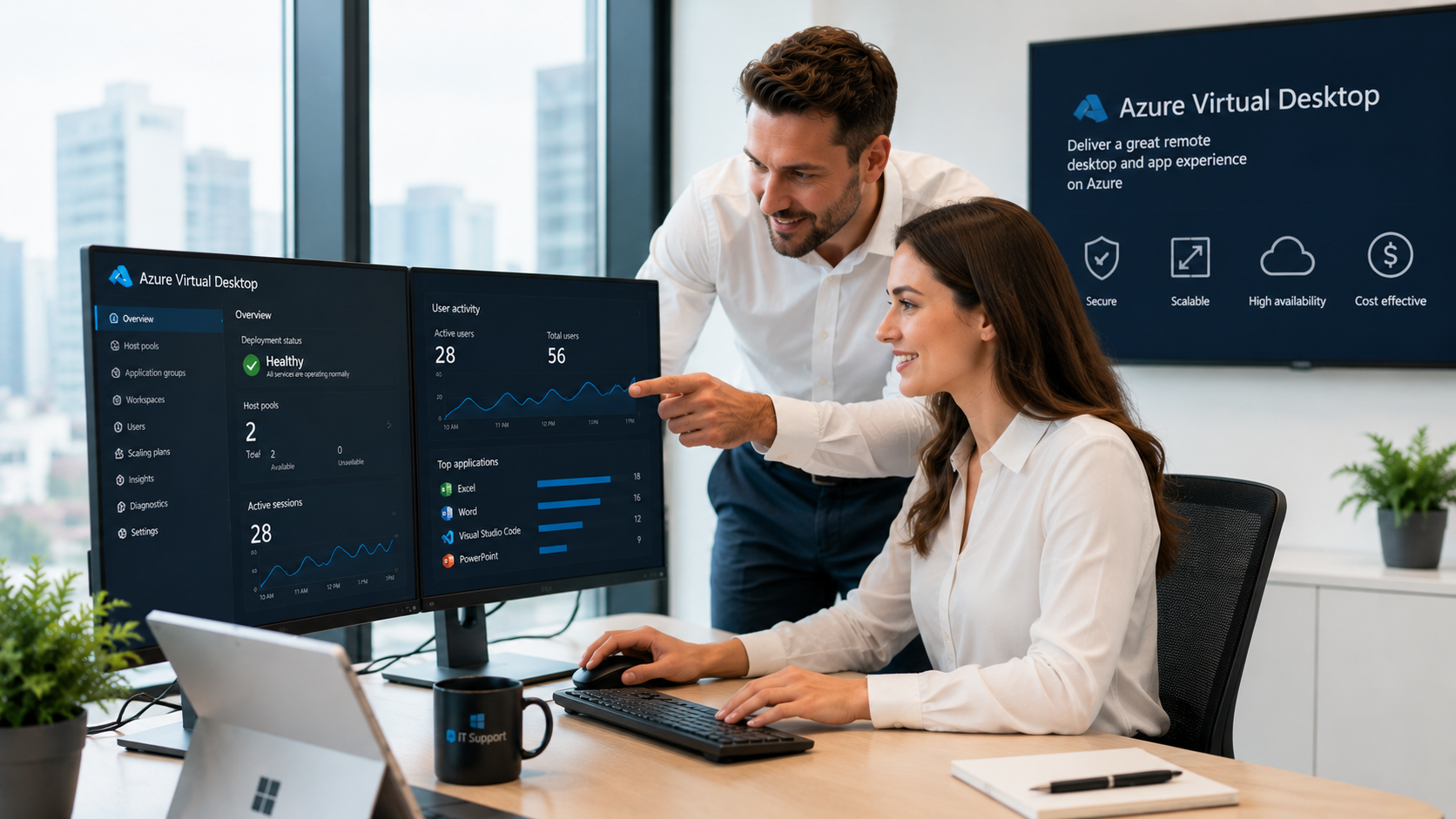
The section uses one cloud operations image to connect discovery, migration sequencing, security posture, and support handoff.
Dependencies, security alignment, migration waves, and operational handoff designed as one modernization path.
Applications, identity, data, networking, and support ownership are understood before move groups are finalized.
Access, logging, Defender posture, and policy expectations are designed into the new environment.
Monitoring, backup, recovery, cost, and support routines are prepared before the migration is considered complete.
Conditional Access, identity governance, passwordless, and secure admin models.
Learn moreOperational device management built for enterprise scale.
Learn morePackaging, update governance, WDAC, and elevation security patterns.
Learn moreBaselines, compliance enforcement, drift governance, and reporting.
Learn moreLegacy modernization is the work of moving older identity, endpoint, policy, application, security, and operations patterns toward a supportable cloud-first operating model without breaking the business processes that still depend on them.
Cloud migration moves workloads or capabilities to cloud services. Legacy modernization also redesigns the operating model, governance, identity posture, endpoint management, and support process so the new environment is easier to run after migration.
Yes. Many environments need staged cloud migration with hybrid boundaries, dependency mapping, controlled pilots, and sequencing that reduces legacy risk without destabilizing operations.
Yes. We design co-management and transition sequencing, including packaging, Autopilot, policy cleanup, cloud migration dependencies, and operational readiness.
Risk is reduced through dependency mapping, controlled pilots, defined success criteria, staged rollout, rollback planning, and operational handover built into the delivery plan.
We will assess your current state, map dependencies, and propose a cloud migration target-state architecture with a staged legacy modernization plan your team can execute and operate.


